The 30% of Dental Calls You're Not Hearing (and What They're Worth)
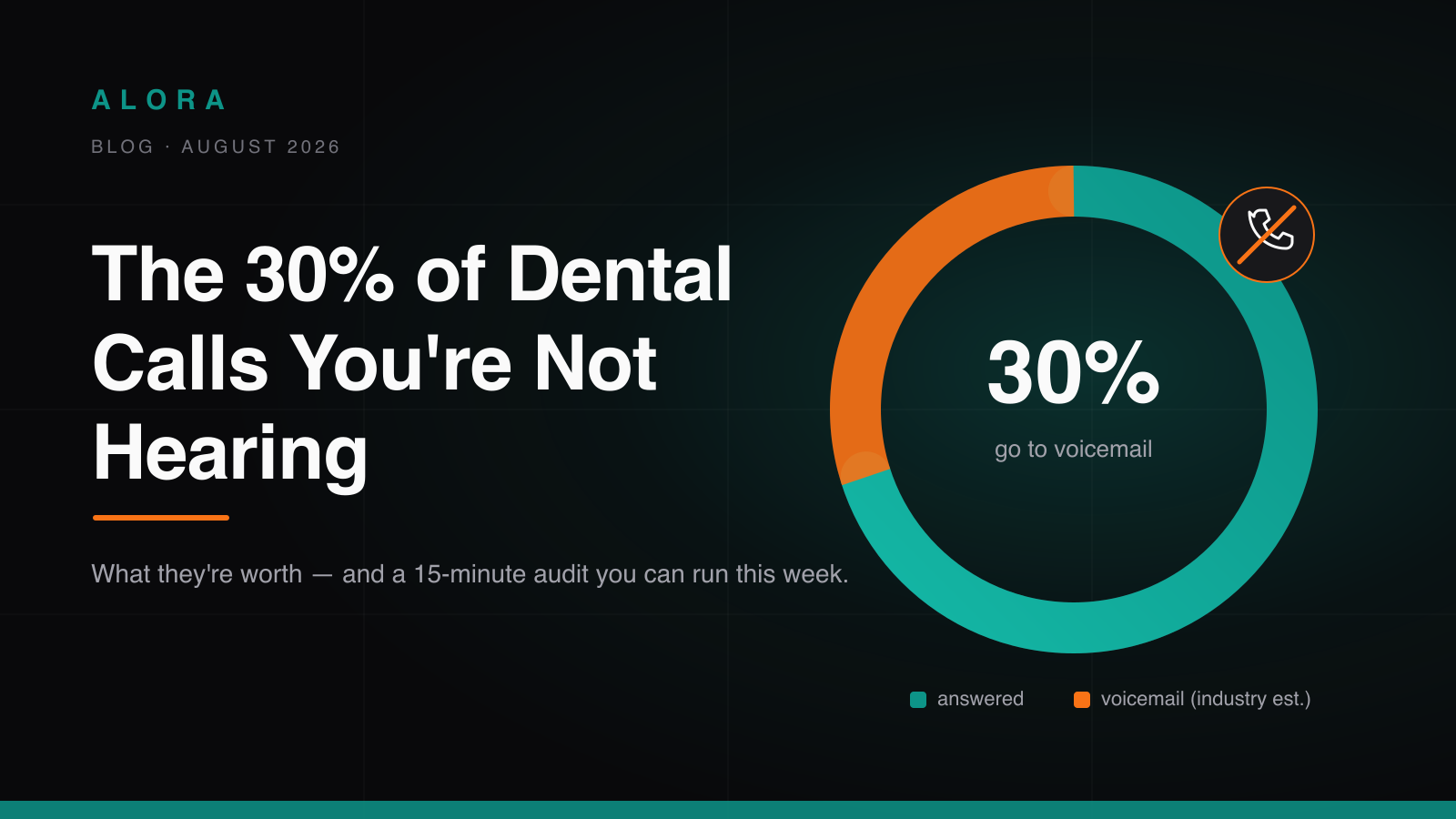
Industry estimates say ~30% of new-patient calls to dental practices reach voicemail. Here's the math — and a 15-minute audit to run on your own numbers.
Step out of the operatory and there are two missed calls in your phone's history. They were probably a patient trying to book a cleaning, and someone asking about insurance. By the time you see the voicemail, the moment when they were ready to say yes has already passed — and often you never get around to calling them back at all.
If you've ever wondered how many dental missed calls your practice is losing, you're not alone in asking. It's one of the most common questions we hear from practice owners, and it's answerable with better precision than most people expect.
The numbers (and where they come from)
Here are the three figures we use when we talk about missed calls. All three are industry estimates from our research corpus (May 2026) — not studies we ran — and the right way to use them is as a starting point for a conversation with your own phone records.
Roughly 30% of new-patient calls to dental practices reach voicemail (industry estimate).
About 45% of new-patient calls arrive outside normal office hours (industry estimate).
The average new patient is worth $500–$800 for the first visit and initial treatment (industry estimate).
None of these is gospel, and any vendor that presents them as certainty is selling something. But each is a reasonable order of magnitude, and together they point one direction: a meaningful share of the new patients who want to see you never reach a human at your practice.
Do the math on your dental missed calls
Try it with your practice. For the example below, assume a small single-provider practice gets about 30 new-patient or booking-related calls a week — a working assumption, not a statistic. The 15-minute audit further down is how you get the real number:
- 30% of those reach voicemail: about 9 calls a week.
- Even if only a third of those would have booked, that's about 3 missed new-patient opportunities per week.
- At the industry-estimated $500–$800 per new patient, that's roughly $1,500–$2,400 a week in lost production from one small practice's missed calls alone.
That's the conservative version of the math. Larger multi-provider practices scale it roughly linearly — and there's a second category that's easy to forget: missed calls from existing patients. A missed reschedule is an empty chair. A missed insurance question is a delayed treatment plan. These don't show up on a "new patients" line item, but they still cost production every single week.
Why it happens (it's not a discipline problem)
First, the important part: this is not a lazy front desk problem. The practices that miss the most calls are usually the busiest — the ones with the most to lose. The causes are structural:
- A single line with no overflow. One ringing line and one receptionist who's in treatment means voicemail, every time.
- Peak demand hits when capacity drops. New-patient inquiries spike in afternoons and evenings — exactly when your team is mid-procedure or already gone.
- Voicemail is a black hole. Many callers never leave a message. And many who do never call back, because the moment they dialed was the moment they were comparing options — and the practice that answered won.
Your three realistic options
1. Add front-desk coverage
The most direct fix: more hours, more people, split shifts to cover afternoons. It works, and nothing wrong with it. The math is what it is — a part-time front-desk hire in a metro market typically runs $18–$25/hour (a wide industry range that varies a lot by market), plus training, benefits, and the fact that it still won't cover 9 p.m. or Sunday. If your volume justifies it, do it. But know what it can't do before you sign the schedule.
2. A human answering service
The classic option, and still a reasonable one. They typically run $300–$1,500 per month (industry estimates, depending on volume and features). The strength: a real person picks up, and patients like that. The limits: many operate on a take-a-message model, so the appointment isn't actually booked until your staff re-enters it the next morning — and quality varies widely between providers. If you go this route, ask directly how appointments get recorded and what the after-hours protocol is for urgent calls.
3. An AI receptionist
The newer option, and the one that's been getting a lot of demos lately. Done well, it answers every call 24/7, books directly into your practice management software, and knows the vocabulary of a dental office — insurance questions, procedure names, emergency triage. Done poorly, it's a generic chatbot wearing a dental skin. We wrote a longer version of this comparison — what AI can reliably do in 2026, what it can't, and the eight questions to ask before you buy — in our post on AI receptionists for dental practices.
The 15-minute audit you can run this week
You don't have to take anyone's word for it, including ours. Most phone systems and carriers will export a week of call logs in a few clicks:
- Pull 7 days of incoming call logs.
- Count the calls that went to voicemail or were missed.
- Divide by total calls. That's your own "30%."
- Multiply by your actual average new-patient value if you know it — or the industry-estimated range above.
That number is yours, and it's the only one you really need. If it's low, keep your current coverage and re-check next quarter. If it's in the range the industry estimates suggest, you now know exactly what the problem is worth — and you can compare any solution's cost against it instead of guessing.
What we're building, and why we're telling you
We're Alora. We're building an AI receptionist specifically for dental practices, because the founder is a practicing dentist who got tired of watching new-patient calls die in voicemail. Alora is in pilot now at a Washington DC practice, and we're onboarding a founding cohort of 10 practices at $250 per month — flat, no per-minute fees. You can read about the founder's background on the About page, and if you want in on the cohort, there's a short form at the bottom of the home page. If you're a newer practice working through this from scratch, our guide for new dentists goes deeper on the revenue side.
We're telling you because the 15-minute audit above works whether or not you ever use Alora — and because most of the math in this post is just subtraction.
Frequently asked questions
Is the 30% number real?
It's an industry estimate — the figure that keeps coming up in practice-management research and operator surveys (our research corpus, May 2026) — not a single peer-reviewed study. That's exactly why the 15-minute audit matters: your own call log beats anyone's benchmark.
Do AI receptionists actually book appointments?
The dental-specific ones do — booking directly into your scheduling software is the entire point of the category. Generic "AI answering" tools usually just take a message. If you're evaluating vendors, this is question one. Our detailed breakdown is in the AI receptionist comparison post.
What happens with after-hours emergencies?
A well-designed system flags the call and routes it to the on-call dentist — it doesn't try to assess clinical urgency itself. Anything involving pain, swelling, or trauma should be a human conversation. This is a line we draw explicitly in our own product, and it's a line you should ask any vendor to draw.
How does pricing compare to answering services?
Alora is a flat $250 per month ($3,000 a year), no per-minute fees, for the founding cohort. Human answering services typically run $300–$1,500 per month (industry estimates). But the honest answer is: run the audit first, and compare any option against what your own missed calls actually cost you.
Want to stop missing calls?
Join the founding cohort